
.jpeg.fe609456798362f843e25f6f00f0bf4e.jpeg)
Rikki
Members
-
Joined
-
Last visited
Everything posted by Rikki
-
Just to be clear, I think this part is a good idea - my suggestion was to go a step further and summarize the contents of those posts pulled out by your own model using AI, rather than just outputting the highlighted posts as-is one after the other. I agree that just feeding an entire topic consisting of 50% junk into an AI summary probably wouldn't give great results. But if you use your signals to pull out the noteworthy posts and then summarize those, I think the result would be likely be pretty good. AI is really good at summarizing text, after all.
-
I clicked into this very excited, thinking you'd be showing off an AI-generated 'executive summary' of topics. Genuinely curious: why not feed those posts with high impact signals into an LLM to summarize? Not long ago your approach would have been great, but now I think will be in danger of feeling pretty clunky, manual and old fashioned. This seemed like it'd be the perfect opportunity to use a modern tool to solve the problem.
-
Shout out to the video editor you've hired ( 😉 ) - the preview videos you're putting out for v5 have been really slick. Way better than those Canva-esque templated ones!
-
This looks really, really good. I'm so glad to see new CSS underpinning everything - about time! Automatically creating color palettes from main colors is lovely too. While we worked towards some of these changes with v4 it was always difficult without breaking the entire ecosystem. I'm happy you've managed to get a clean break.
-
I see @Ehren came around to Tailwind 😉
-
Looks great, good job on tackling some of the oldest bug bears 🔥
-
I think supporting one level of sub-comments (a la stack overflow, or even status updates in IPS profiles) in forum topics and then putting answers to questions as sub-comments would be a great improvement and make it a bit easier to follow the flow of live topics. I've found this one a bit more difficult to follow post-liveness.Looking forward to seeing how Live Topics has turned out 🎉I took a position at Help Scout as a JS engineer 🙂Oh no, he's going to add that to the list now.That's an amazing opportunity - best of luck @Jordan Miller. You brought a zeal to IPS that was sorely needed and hopefully it'll continue after you're gone.Sometimes, turning the relationship on its head and actually employing the troll can have a beneficial outcome.Thank you everyone, I'm sad to be leaving but very excited for what comes next. I'm sure you'll still see me around here, just without that Staff badge.You don't have 'a' server when running in the cloud. Our cloud platform has hundreds of instances (which doesn't even necessarily equal the number of actual physical servers) and your site is running on all of them at once. Which one actually handles a user request is decided by a load balancer.You can do location based rules, so you could have one that awards a badge when a topic is posted in a certain forum, yes. You can't award certain badges based on member group though. Showing some recent badges is in the postbit is a good idea that we can consider. I'm wary of adding too much noise though, so it'd be a balance. The badge system we're discussing doesn't interact with member groups right now. We have spoken about tying the achievement and group promotion systems together in future, and that'd likely open up more possibilities along those lines.Badges already support this - when you create the rule that awards the badge, you can enter a member-facing summary of the rule, e.g. "You posted 50 replies!".What you're describing is closer to the Badges part of the system, where you earn a badge for doing a particular thing. We don't currently list all badges and what you have to do to get them (but may later), but when you earn a badge we do indicate in your profile what you did to earn it. Ranks however are based on points, and you earn points by doing all sorts of things in the community, with the rules defined by admins. You could earn enough points by creating one topic, or by replying to ten topics, or reacting fifty times - it could be any combination of actions, there's no one thing you have to do.
 As we approach the release of Invision Community 4.6, I wanted to take you through some improvements for using Invision Community on a mobile device. Web push notifications For some time, we've used the local browser notification API to show users notifications. There's a big drawback though: users had to have the site open in a tab for these to work. This is particularly problematic for mobile devices. In 4.6, we've added support for the WebPush API, which allows sites to push notifications to users' browsers & devices even if the site isn't open - or even if the device is asleep. We already have support baked in for push notifications via our beta mobile app, so we've piggy-backed on that system and expanded it to support browser-based push notifications. Choosing push notifications For users, it's a simple process. A little while after joining a community they will prompted to accept notifications from the site when they open the notification list dropdown (or they can opt-in any time from the notification settings screen). After accepting, they will be able to choose a "Notification List + Push" option for any of the available notification types. Push notifications enabled Existing users, who may have already granted permission to the site in the past, will be re-prompted to accept push notifications upon logging in after the 4.6 upgrade. Push notifications typically show on the homescreen of a phone or in the notification tray of a desktop computer, so receiving dozens of notifications could be overwhelming. For that reason, Invision Community will automatically merge related notifications - for example, multiple mentions from the same topic, or multiple new topics from the same forum. Grouped push notifications And, of course, users can stop push notifications across all of their devices with a single click if they want to opt out. We're excited about the engagement potential of push notifications, since they allow you to immediately reach users who aren't currently on your site - a job previously left to email alone. On the subject of notifications, one more thing: we've heard your feedback about notifications for new replies/mentions being merged with notifications for likes/quotes, and will be separating these two types into their own permissions in 4.6. We're acutely aware that making notifications annoying results in users turning them off, so we're always looking to ensure there is a reasonable balance. Splash Screen Images When you add a website to your phone's desktop, it appears like a native app. Tapping to launch the site can show a blank screen for a few seconds while the website is loaded. Fortunately, you can now set a 'splash' image in the Admin CP which is shown when launching the app. Sharing using native share options Another enhancement coming in 4.6 is the addition of the device share sheet when sharing content from within Invision Community. Users will now see a "More Sharing Options" button (providing their device/browser supports the underlying API) which, when tapped, will open the device share sheet. The options available depend on the device, but typically include actions like sharing links in WhatsApp, posting to Facebook or creating a note. Offline support With a larger share of users now using mobile devices for most of their browsing comes the problem of patchy phone signal and internet connections dropping out. For a dynamic web-based platform like Invision Community, it's difficult to offer much in the way of full offline support, but starting in 4.6 we will present a branded offline page to users when they have no internet connection and try to access the community. We hope that you are looking forward to these PWA improvements coming in Invision Community 4.6!
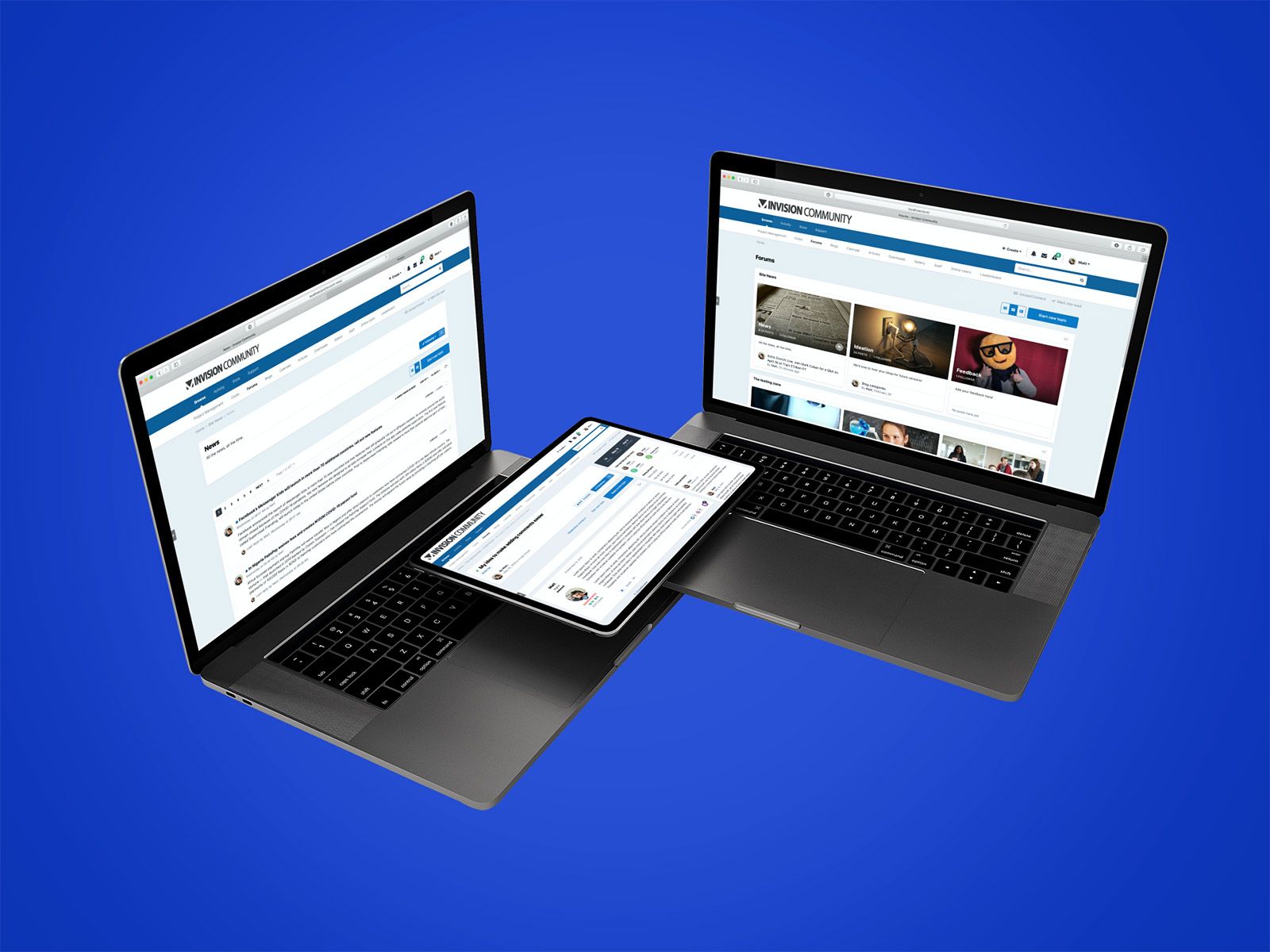 If you've been around Invision Community for a while, you'll know our frontend default theme hasn't significantly evolved since the early days of 4.0. Indeed, the last significant refresh came with 4.2. With the upcoming release of 4.5, we wanted to revisit the default theme and give it a facelift for 2020, as well as make incremental improvements to the underlying codebase as a stepping stone to a bigger re-engineering in a future version. In this entry, I want to talk a little about some of the design decisions that went into building the new theme. Goals Redesigning for the sake of it is never a good idea, so we first laid out what we wanted to achieve: A brighter UI with more saturation & contrast and simpler overall color scheme Improved typography Better, more consistent, spacing around and between elements, especially on mobile Better logical grouping of sections of each page Reducing underutilized links/buttons on the page and finding alternative ways of making them available Improving how post states are displayed Modernizing and enhancing the underlying code that powers the default theme Let's talk a little about each of these. Brighter UI The most obvious change will be that our default colors are brighter and more saturated than before. Before making any changes, we first created a color scale for both neutrals and the brand color (blue, of course). This gave us a flexible but consistent palette of colors to choose from, with appropriate contrast built in. Neutrals have a touch of blue too to avoid seeming washed out. We've simplified the style, in particular reducing reliance on background colors to differentiate sections within cards (a card essentially being an ipsBox, for those who are familiar with our framework). Instead, we use spacing, borders and appropriate typography to achieve visual separation. Brighter default colors Simplifying the UI by removing block backgrounds Improving typography We've felt our typography has been somewhat muddled for some time - with a mixture of sizes, weights and colors used depending on the particular context. The first step to improving it was to create a typography scale that we could refer to and implement, to ensure we remained consistent throughout the product. Our typography scale (The keen-eyed amongst you may also notice we've switched our default font to Inter. Inter is a fantastic open source font that is ideal for text on the web, and was recently added to the Google Web Fonts project making it super simple for us to incorporate it into our default theme.) We've been much more deliberate about applying type styles, especially for titles, ensuring that they are always visually distinct from surrounding text. We've done this through both color and weight. As a result, pages should instinctively feel more organized and logical than before. An example of improved typography, from the Downloads app Improved spacing (especially on mobile) We identified that spacing (padding and margins) needed some improvement. A lot of spacing values were arbitrary and inconsistent, leading to poor visual harmony across any given page. Most troubling of all, on mobile sizes we simply halved desktop padding values. While this was a reasonable approach in the days of phones with small screens, it has felt decidedly dated for some time. Phone screens are now typically larger and able to accommodate roomier UIs without appearing comical. In 4.5, we have done away with that approach, and the impact was immediate. Mobile sizes now get a much more pleasant interface, with elements having room to breathe. In addition, we've also made most cards full-width to provide additional breathing space for content. Posts can finally breathe on mobile There are numerous other tweaks across the product too: default spacing has been increased a little, data tables (e.g. topic listing) get extra vertical spacing, and spacing between elements has become more consistent. Improved grouping of related elements Prior to 4.5, most content areas existed inside cards. However, one notable exception to this was page headers and as a result, they could feel particularly disorganized, especially for users who had many controls in this part of the page (such as staff). To solve this problem, we've developed a new, standardized design for content item page headers, giving them their own cards and consistent button placement. Topic view header Some areas don't necessarily fit into the same design pattern above. In those areas, we've tweaked styling to suit the context, while still adhering to our overall aesthetic. Calendar header Messenger conversation header Reducing underutilized links/buttons Finally, another area we identified as needing improvement is the abundance of tools, made up of links and buttons, across pages. Many of these are only used occasionally and so would be better moved out of the main view to simplify the page. Two particular areas we focused on were share links and postbits (both forum posts and comments in other apps). Research shows social share links are used by a vanishingly small percentage of users, so even though they were at the bottom of the page, it was unnecessary to make them so prominent (given their eye-catching colors). To solve this, we've added a share link to the page header, with the social network links themselves in a popup menu. The result is ideal: sharing functionality is unobtrusive but obvious. Share links in content items Comment areas have also suffered from 'button creep' over the years. A typical comment will contain a report link, a share link, a quote link and multiquote button, reactions, plus IP address, checkbox, edit and options links for certain users. That is a lot of visual noise around the important part: the content. We've therefore simplified comment boxes as much as is reasonable. Reporting and sharing comments/posts is now available in the post options menu, as are any tools for the author/staff. Quoting and reacting are two primary interactions for users, so they of course retain their position in the control bar. Simpler postbits, even for staff Improving post states Posts/comments in Invision Community can have many states - sometimes more than one. Posts can be hidden/unapproved, popular, recommended, solved (new in 4.5!) or highlighted because of the author's group. It's always been a challenge to indicate these statuses well. In previous versions, we added a border but the most prominent indicator was a flag in the top-right corner of the post. This had three problems: Due to the lack of space (thanks to report/share links), showing more than one flag was difficult. Showing any flags on mobile was messy because of the space constraints. The meaning of the flags was not obvious, especially to new users. Group-highlighted posts had no flag, just a border, which made them even more difficult to understand. With the top-right corner of posts now tidied up and free from fluff, we were able to much more effectively use this space to indicate post statuses. In 4.5, posts and comments will show badges when they have a particular status, as well as a more attractive semi-transparent border. For group-highlighted posts, we show the group name instead (the colors of this highlight are still controllable via theme settings). A post with two states: group highlighted and popular This works much better on mobile too, where the status badges get the prominence they deserve: Mobile post statuses Modernizing the underlying code I wrote about the technical improvements behind the theme in a previous entry. If you're a theme designer or edit the theme for your own community, go and check it out now! Wrapping up As well as these large-scale concepts, you'll notice many other smaller enhancements as you start using the new theme. I've shown some snippets of pages in the screenshots above, but I've included some full-page views below so you can see the overall aesthetic and how these pieces fit together. Modernizing and refreshing our default theme has been needed for some time, but we view this as just a stepping stone to future work that will be reserved for a major version bump, and we're excited to figure out where we go next. Screenshots Desktop forum views (click to expand) Mobile forum views (click to expand) Activity streams & messenger (click to expand)
 If you've been around Invision Community for a while, you'll know our frontend default theme hasn't significantly evolved since the early days of 4.0. Indeed, the last significant refresh came with 4.2. With the upcoming release of 4.5, we wanted to revisit the default theme and give it a facelift for 2020, as well as make incremental improvements to the underlying codebase as a stepping stone to a bigger re-engineering in a future version. Keep an eye out for our next blog for more on the facelift. In this entry, I want to go over some of the design and code-level changes we've implemented that will be of particular interest to third-party theme designers, or those building a custom theme for their community. IE11 Support Until now, we've supported IE11 as a 'B' browser - meaning we didn't aim for perfect support (especially visually), but did aim to make all functionality work, and we fixed IE11-specific issues if possible. As of 4.5, we no longer support IE11 in any way and Invision Community will not work well in that browser. By removing support for IE11, we are able to make use of newer CSS technologies which significantly eases development for us and third-party designers. I'll discuss some of those below. Combined theme settings We've combined a number of existing theme settings into one new setting. We've found that settings like poll_bar, step_background, rating_hover and so on are nearly always set to the same color - typically the site's main brand color. These settings have therefore been replaced with one new brand_color setting, which is used throughout the CSS in places where this primary color would be needed. This will simplify the early stages of theme development and make it easier to match branding in Invision Community. Front end colors Removing hardcoded colors While our theme settings have allowed community owners to change most colors, there were still many hardcoded in our CSS framework. These were typically neutral colors used for things like 'close' links, semi-transparent backgrounds and so on, but it was enough to make creating a dark theme an unrealistic prospect without an awful lot of effort (and kudos to those designers who have offered dark themes up until now!). In 4.5, we've removed hardcoded colors from our framework, and instead rely on colors already defined by theme settings. You can now, finally, create a dark theme just by editing the built-in theme settings. Type scale & {fontsize} tag While we've had fixed type-size classes (e.g. ipsType_normal) for a long time, in practice many elements had their own font sizes set. This leads to inconsistency and poor visual rhythm too. Another side effect is it was also tough to globally change the font size (such as for branding purposes, or to create a theme for visually-impaired users). To solve these problems, we first created a type scale; that is, a fixed number of sizes to choose from. A product the size of Invision Community does have need for a flexibility, so we settled on the following scale: x_small: 12; small: 13; medium: 14; base: 16; large: 18; x_large: 20; 2x_large: 24; 3x_large: 30; 4x_large: 36. All of these values are editable as theme settings, so each theme can adjust the type scale used. Our default CSS in 4.5 has been fully updated to put all type on this scale. To actually make use of these settings, we have added a new {fontsize} tag which accepts either a scale key, or a specific pixel size (for those occasional situations where a specific size is absolutely needed, e.g. icons). Why couldn't we just use {theme="x_small"}, or even CSS variables? To solve the problem of globally scaling text, we have also added a percentage-based scale setting that will save you from having to create your own type scale. The {fontsize} tag automatically applies the global scale to any values passed into it. Want text in your theme to be twice as big as default? Simply set the global type scale to 200% and the entire theme will reflect the change immediately. The new font size options Spacing scale The lack of a consistent spacing scale has led to some arbitrary values being used in any given situation, which again has had a negative impact on the visual harmony of our design. We've therefore implemented a 4px spacing scale (using CSS variables rather than theme settings this time) and applied across almost all padding/margin values. In time, we anticipate fully switching all measurement values to the scale. New CSS class families We have added a range of new spacing classes for padding and margins, allowing far more control over how these are applied, especially on different device sizes. Previously, ipsPad (15px) was simply halved on small screens - with no 'opt-out' short of adding specific CSS. We've felt this has been imprecise for some time, especially since mobile devices typically have larger screens in 2020 and don't need to be so tightly-spaced. ipsPad_all now replaces the existing ipsPad, and does not halve itself on small screens. Instead, there's a new responsive naming convention that allows you to apply specific padding on specific device sizes: ipsPad_all:double md:ipsPad_all sm:ipsPad_all:half In this arbitrary example, desktop size (the default) get double padding, medium (tablets) get regular padding and small (phones) get half padding. We've added similar classes for top, bottom, left and right padding, as well as horizontal, vertical and none (to removing all padding) shortcuts. For margins, the old ipsSpacer_* classes have been replaced with a new ipsMargin family that work exactly the same as the padding classes above, with the same range of flexibility. The old ipsPad/ipsSpacer classes will continue working as they did before for backwards compatibility, but should be considered deprecated from 4.5 onwards. We've also added a whole range of new ipsFlex classes, also with responsive controls (making it easy to have horizontal layouts on desktop and vertical layouts on mobile, for example), as well as a new ipsGap utility that automatically adds spacing between elements, without requiring manual :first-child/:last-child exclusions. CSS variables & calc() In 4.5, thanks to IE11 support ending, we're finally making use of CSS variables and calc() to make CSS more maintainable and easier to customize. A lot of repeating or often-customized styles - such as form field styles, message colors, card styles, border radii etc. - are now created as CSS variables, allowing theme designers to easily change styling in one place. Instead of magic numbers, we either stick to our spacing scale, or use calc() to avoid hardcoded numbers. The future The work we've done so far is just a 'first-pass'. We'll be pressing forward with modernization throughout the 4.5.* series and beyond with a view to reducing our footprint, improving our ability to maintain our CSS and, of course, making theming easier for our customers.For the most part, themes created for Invision Community 4.3 should work without modification on Invision Community 4.4. However, for sites with more heavily customized themes, there may be some manual updates you will need to make to ensure compatibility. The document below outlines the areas you should review. We'll update the document as and when we identify particular areas that may be causing upgrade problems. Global includeJS If you have modified includeJS.phtml, you will need to add two new keys to the main ipsSettings settings block in order for lazy loading of media to work correctly: lazyLoadEnabled: {{if \IPS\Settings::i()->lazy_load_enabled}}true{{else}}false{{endif}}, blankImg: "{expression="\IPS\Text\Parser::blankImage()"}", Pages Record Templates Next unread links If you have modified any of the record view templates in Pages, you may encounter a template error after upgrading. The format of data passed to generate the next unread record link has changed. In your database record template change: <div class='ipsGrid ipsGrid_collapsePhone ipsPager ipsClearfix ipsSpacer_top'> <div class="ipsGrid_span6 ipsType_left ipsPager_prev"> {{if $record::database()->use_categories}} <a href="{$record->container()->url()}" title="{lang="cms_back_to_category_with_title" sprintf="$record->container()->_title"}" rel="up"> <span class="ipsPager_type">{lang="cms_back_to_category" sprintf="$record::database()->recordWord( 2 )"}</span> <span class="ipsPager_title ipsType_light ipsTruncate ipsTruncate_line">{lang="$record->container()->_title"}</span> </a> {{else}} {{$page = \IPS\cms\Pages\Page::$currentPage;}} <a href="{$page->url()}" title="{lang="cms_back_to_category_with_title" sprintf="$page->_title"}" rel="up"> <span class="ipsPager_type">{lang="cms_back_to_category" sprintf="$record::database()->recordWord( 2 )"}</span> <span class="ipsPager_title ipsType_light ipsTruncate ipsTruncate_line">{$page->_title}</span> </a> {{endif}} </div> {{if $nextUnread !== NULL}} <div class='ipsGrid_span6 ipsType_right ipsPager_next'> <a href="{$nextUnread->url()->setQueryString( array( 'do' => 'getNewComment' ) )}" title='{lang="cms_view_next_unread_title" sprintf="$record::database()->recordWord( 1 )"}'> <span class="ipsPager_type">{lang="cms_next_unread_title" sprintf="$record::database()->recordWord( 1 )"}</span> <span class="ipsPager_title ipsType_light ipsTruncate ipsTruncate_line">{$nextUnread->mapped('title')}</span> </a> </div> {{endif}} </div> To: <div class='ipsGrid ipsGrid_collapsePhone ipsPager ipsClearfix ipsSpacer_top'> <div class="ipsGrid_span6 ipsType_left ipsPager_prev ipsPager_noDesc"> {{if $record::database()->use_categories}} <a href="{$record->container()->url()}" title="{lang="cms_back_to_category_with_title" sprintf="$record->container()->_title"}" rel="up"> <span class="ipsPager_type">{lang="cms_back_to_category" sprintf="$record::database()->recordWord( 2 )"}</span> </a> {{else}} {{$page = \IPS\cms\Pages\Page::$currentPage;}} <a href="{$page->url()}" title="{lang="cms_back_to_category_with_title" sprintf="$page->_title"}" rel="up"> <span class="ipsPager_type">{lang="cms_back_to_category" sprintf="$record::database()->recordWord( 2 )"}</span> </a> {{endif}} </div> {{if $nextUnread !== NULL}} <div class='ipsGrid_span6 ipsType_right ipsPager_next ipsPager_noDesc'> <a href="{$record->url()->setQueryString( array( 'do' => 'nextUnread' ) )}" title='{lang="cms_view_next_unread_title" sprintf="$record::database()->recordWord( 1 )"}'> <span class="ipsPager_type">{lang="cms_next_unread_title" sprintf="$record::database()->recordWord( 1 )"}</span> </a> </div> {{endif}} </div> This change also affects topic view, however you should use the built-in template editor tools to compare and update your custom template. Follow buttons If you see an error accessing your records (or in the system log) that use a custom template such as "Total count attempted on a query not ran with SQL_CALC_FOUND_ROWS" you will need to make some changes to your template to make it compatible with 4.4. Change (2 instances) of {template="follow" app="core" group="global" params="'cms', 'records'.$record::$customDatabaseId, $record->primary_id_field, $record->followers()->count( TRUE )"} To {template="follow" app="core" group="global" params="'cms', 'records'.$record::$customDatabaseId, $record->primary_id_field, $record->followersCount()"}
 Making security considerations a key part of your community setup and maintenance can save you from many future headaches. You've worked hard to get your community moving. Don't make yourself an easy target and undo that work. Here’s our current advice to our customers. 1. Enable HTTPS HTTPS is fast becoming the standard way to serve websites. In 2016, more than 50% of web requests were served under HTTPS for the first time. Chrome and Firefox now explicitly warn users on login forms that aren’t sending data over HTTPS, and it’s not hard to imagine that in the near future all insecure pages will receive the warning. HTTPS simply means that website data is served over a secure connection and can’t be read or tampered with by a ‘middle man’ hacker. You can identify a site using HTTPS because the address in your browser will show ‘https://’ (instead of http://), and normally a lock icon or the word ‘secure’. Invision Community supports HTTPS by default simply by changing your base URL configuration to include HTTPS. Of course your web host will need to support it as well and our Invision Community Cloud services support it by default. Contact support if you have any questions. Recommendation: Set up HTTPS for your entire community to prevent ‘man in the middle’ attacks. 2. Set up Two Factor Authentication Invision Community supports Two Factor Authentication (2FA for short), and we highly recommend making use of this feature for your users, but especially for your administrator staff. 2FA is a system that requires both a user’s password and a special code (displayed by a phone app) that changes every few seconds. The idea is simple: if a user’s password is somehow compromised, a hacker still wouldn’t be able to log in to the account because they would not have the current code number. You may already be familiar with 2FA from other services you use. Apple’s iCloud, Facebook and Google all offer it, as do thousands of banks and other security-conscious businesses. Invision Community supports 2FA via the Google Authenticator app (available for iOS and Android) or the Authy service, which is able to send codes to users via text message or phone call. You can also fall back to security questions instead of codes. You can configure which members groups can use 2FA, as well as requiring certain groups to use it. Recommendation: Require any staff with access to the Admin Control Panel or moderation functions to use 2FA, to ensure that no damage can be done should their account passwords be discovered. Allow members to use 2FA at their discretion. 3. Configure password requirements The password strength feature displays a strength meter to users as they type a new password, showing them approximately how secure it is, as well as some tips for choosing a good password. While you can leave this feature as a simple recommendation for users, it’s also possible to require them to choose a password that reaches to a certain strength on the meter. Recommendation: Require users to choose at least a ‘Strong’ password. 4. Use Admin restrictions It’s very common that many different staff members need access to the Admin Control Panel depending on the role. You may have design staff, billing staff, community managers, and so on, all with particular tasks they would like to achieve. Invision Community can help improve the security of your Admin Control Panel by allowing you to restrict the functions available to each administrator, granting them access to only the tools needed to do their job. Recommendation: Audit your community’s administrator accounts and applying restrictions where it makes sense to do so. 5. Stay up to date It’s important to ensure you’re always running the latest release of Invision Community. With each release, we add new security features, audit code and fix any issues reported through responsible disclosure. Falling behind can therefore make your community a tempting target for potential hackers. Your Invision Community Admin Control Panel will let you know when a new release is available, and you can also check out our Release page to track releases. For our Enterprise customers, we’ll automatically apply updates for you shortly after release as part of your plan. For our self-hosted and Cloud customers, you can easily apply new updates via the Admin Control Panel with a couple of clicks. Our Invision Community Cloud contains all best practices for security. However, if you are self-hosted, be sure to work with your web host to ensure your server is setup properly. Ensuring that server software, firewalls, and access controls are in place is very important as an insecure server can be your worst enemy. Recommendation: Aim to install latest updates as soon as feasible. 6. IP address restrictions For organizations where staff are centrally-based in one location, or are required to use a VPN, you can improve your community security by restricting access to the Admin Control Panel to the IP addresses your staff will be using. This is a server-level feature, so contact your IT team to have this facility set up your installation. Enterprise customers who wish to utilize IP restrictions should contact our Managed Support team, while Cloud customers can submit a support ticket to have this set up. Recommendation: Where staff all access the community from a small number of IP addresses, restrict Admin Control Panel access to those IPs. Summary Don’t leave security as an afterthought. Invision Community includes a range of tools to help you ensure your data and members protected, as well as industry-standard protections ‘under the hood’. Make use of these features, and they’ll help ensure the wellbeing of your site. As always, if you have any questions or need advice, our support team are on hand to assist you.
 Unlike a regular website, where you write content for each page, target keywords and optimize text, a forum community's content is predominantly written by users. They don't know or care about your site's SEO and just want to interact with other users or find answers to their questions. To keep your community moving forward, Invision Community implements many best-practice SEO techniques and approaches for you automatically, without you needing to lift a finger. Even still, there are a few additional steps you can take to potentially help your site rank better. How Invision Community helps you automatically Invision Community does a lot of automatic SEO for you behind the scenes to help your site rank better or to help search engines understand your content. Some of those include: Sitemap generation A sitemap file helps search engines to locate pages within your site. This helps search engines find pages so they will be crawled quicker. Invision Community automatically generates a sitemap for you that points to all of your content URLs, and submits it to Google. JSON-LD Another way a site can help search engines is by providing metadata about a page. For example, if the page contains a review, additional data can be supplied to the search engine with rating count, average, and so on. There are dozens of items that can be described in this way, and doing so can mean your results in search engines display this additional data. This makes results more useful to users, potentially leading them to click on your result versus another. It can also help search engines understand your content better. Canonical URLs Search engines can penalize your site in situations where the same content can have multiple URLs. With software that generates pages dynamically, such as a community, this can happen frequently because there are URLs to get the last read post, the latest post, the first post and so on, all ultimately pointing to the same topic page. Invision Community takes care of this for you by setting a canonical URL for every page, telling the search engine which is the definitive URL it should use. Semantic markup The HTML markup used to generate a page is possibly the most important factor impacting SEO. Each HTML tag has a specific meaning (e.g. H1 is an important title) and allows search engines to determine the structure of the page. It's therefore important that tags are used correctly and in the appropriate context - known as semantic markup. Invision Community has been built with semantic markup principles in mind right from the start. Responsive theme Google has been transitioning to a mobile-first approach when crawling sites and it's likely this does or will factor into its PageRank system. Now more than ever it is important that your community offers a genuine mobile experience. Invision Community achieves this by supporting responsiveness - where the theme adapts depending on size of the screen being used - by default. What you can do to improve ranking Let search engines see your content One of the most important things you can do to help with SEO might seem obvious, but we've seen many people unwittingly neglect it: ensure that search engines can see your content! It's tempting to lock down your community so that users have to log in before being able to see your content, and for some communities this might be necessary. However, a search engine can only see content accessible to guests, and so by locking your community down a search engine won't be able to see very much at all, and your pages won't show in search results. Wherever possible, we suggest allowing guests to read your content, though you can require registration to reply. Enable HTTPS Even ignoring SEO this is a good idea, because it's more secure for your users and browsers are increasingly alerting users about sites that don't use HTTPS, showing them as insecure. In terms of SEO, research has shown a correlation between between sites using HTTPS and their ranking position, and in 2014 Google indicated that HTTPS would be a “ranking signal” going forward. Given the other benefits of HTTPS, it would therefore be wise to enable it across your community. Ensure your site loads fast A fast-loading site is very important for rankings, and so you should do what you can to keep your community running quickly. This includes: Enable guest caching Invision Community includes a built-in caching system for pages viewed by guests, ensuring they don't have to be re-generated for every page view. This can greatly speed up your site for guest users and therefore search engines. This is automatically configured on our Cloud services. Don't go overboard with plugins A few good plugins can set your community apart from others, but going overboard can significantly slow down your load times or clutter your interface. Be wary of image-heavy themes As with plugins, a great theme is a good thing to have, but try to avoid one with extensive use of very large images. Choose a good host Some website hosts are slower than others, so ensuring your host is up to scratch is important. Of course our Cloud services are a great solution here! Use 301 Redirects if migrating If you're migrating from another community platform, your page URLs will change to reflect Invision Community's architecture. You can greatly improve SEO retention by using special redirects (known as 301 Redirects) to send users from your old URLs to the new. Search engines understand this method and will update their records. We include redirects in our free migration packages to help you retain your SEO standings after migrating to Invision Community. Write relevant content If your site targets a particular niche, you may see benefit in writing longer-form content as articles on a site blog. This kind of content ranks well and allows you to ensure keywords are used (versus content posted by members, which can be anything). You can also encourage further discussion of the article in the wider community, amplifying its benefit. For a site news page/blog, our Pages app can be used to build an articles section for this purpose. Use social media profiles to your benefit You should register social media profiles for your site on the popular platforms and make them a part of your presence. These sites rank very highly of course, and so if your social profiles can also rank highly for your name, they can be a good way of directing traffic to your site. Use the ‘About' section of the profile to write an interesting blurb about what your site offers. Create eye-catching header images and profile photos to use on the profiles too. Cross-link each social profile to the others (and back to your site, of course). Finally, link to your social profiles from your site too. Invision Community allows you to easily do this and insert icons in your header or footer. Beyond that, you can also use social media to your advantage by cross-linking some of your best content to it. We'll go into more detail on how best to leverage social media in a future article, but the new Promote functionality in Invision Community is a great way of achieving this. Summing Up As always, content is king when it comes to ranking, and that should be your most important focus. Fostering a vibrant community that creates and shares interesting content is key. You can then use SEO methods boosted by Invision Community features to expand your community's reach in search engines. If you have any SEO tips that have helped your site, we'd love to hear them. Share them in the comments below!
 Whether you run an existing community or are taking tentative first steps into setting up an online community forum around your brand, an important choice you need to make is between social networks like Facebook or having a community you own and control. Let's take a look at the benefits of an owned community versus a Facebook group - as well as how you can still use Facebook (and other social media platforms) to your advantage. You own your data The biggest point to consider when using Facebook groups is that you do not own your own data. Facebook owns it and does not even allow you direct access to it. If you decide later to move to a different platform, need to run reports to extract meaningful insights, or otherwise work with your community data: you are out of luck. In contrast, with an Invision Community, your data is your data. You can use it in any way that makes sense for your goals; be it analyzing trends, sending promotions to users, or generating reports and statistics. We never hold your data hostage and there's no fee to get it. Beyond owning the data, you also control how it's used and presented. Facebook is notorious for changing algorithms for when (or even if) people see your posts. When you run your own community the experience for your and your users is in your control. Branding opportunities This is a big one. An owned community gives you the tools you need to make your community a seamless part of your user's interaction with your business. This naturally includes your brand styles (your logo, colors, site navigation and so on) but also your community web address (URL). With an owned community, your URL will be easy to find - customers normally opt for something like forum.yourname.com or community.yourname.com. Users will have more confidence that they're in the right place, and more closely associate your community and your message with your brand. Emails sent out by your owned community can also carry your branding, consistently reinforcing that connection between your business and your community. And, of course, when users share content from your community to Facebook and other social networks, they're sending users directly to your website where you have the opportunity to lead with your most important call to actions. More control over user experience All Facebook groups are, essentially, the same experience and yet your business needs almost certainly aren't the same as every other. One size doesn't necessarily fit all when it comes to community! When you control your own community, you have the ability to control your user's experience. Need to show specific types of data in specific places? You can do that (and more) with Invision Community's easy to use Blocks feature. Need to create a custom community application to serve as a resource center for product support? You can do that too. Another huge benefit of this control is that, unlike a Facebook Group, users won't be seeing ads and 'recommended content' from competing businesses and communities. With user attention being pulled in so many directions these days, the last thing your community needs is for users to leave because Facebook has suggested a competitor! No barriers to monetization Not all communities require a monetization strategy. In many cases, the community is part of a larger customer relationship strategy rather than a revenue-generating destination in its own right. But for those communities that do plan to monetize, options with a Facebook group are at best difficult to act upon, and at worst practically non-existent. In contrast, Invision Community gives you the opportunity to explore monetization strategies that work for you. These might include paid subscription plans (a particularly attractive option for fan club communities), traditional advertising through Google AdSense and other networks, or sponsorship deals with other businesses that might be relevant to your members. Invision Community has tools for each of these approaches built in, allowing you to start monetizing with minimum fuss. Fine-grained permission controls Facebook groups struggle to reflect the real-world roles that staff members play in your organization, limiting your choices to 'administrator' or 'moderator'. And the same is true of users, too - your options for recognizing different levels of user (such as VIPs, or brand ambassadors) are limited. Invision Community is different. Since you are creating and configuring each member group, you can precisely control who can see what, and how they are recognized within the community. You can even sync these roles via Single Sign-On (SSO) making setup and assigning users to groups painless. For staff groups, you can limit access to key community functions based on roles or responsibilities, ensuring access is granted on an as-needed basis only. For users, you can get creative and find a group structure that works best for your specific needs. For example, support communities often find that recognizing the most knowledgeable and helpful members with a new member group (complete with elevated permissions) is a great way of engaging users. And finally, with this control over access, it's very easy to create restricted areas of the community. Whether you want to create a private subforum that staff can use to coordinate tasks or a file repository that's only available to subscribers, Invision Community can achieve it. You can still reap the Facebook benefits Setting up your community within Facebook's walls might not be the best approach for you. That doesn't mean you should ignore Facebook, however. On the contrary, it's an influential platform and there's a very good chance your users are already using it. Invision Community offers a number of tools that allow you to benefit from Facebook while avoiding the drawbacks we discussed. We'll go into more detail on utilizing social media in a future article, but to summarize: Invision Community features social sign-in options, enabling users to register and log in using their existing social media accounts, substantially reducing onboarding friction. Content can promoted by staff back to your social network pages, automatically and on a schedule you decide. Invision Community supports automatic embedding of a wide number of social networks (and other services), allowing users to share their favorite Facebook and Twitter posts and spark a whole new conversation - but this time in your community. Summary When you are creating an online community for your business or hobby it is important to think about your goals and future growth by choosing a platform that is there to work for your needs. When you establish your community on Facebook, you're helping to grow someone else's business (including, potentially, your competitors!) and hoping that some of those spoils fall to you. With an owned community, the rewards of your hard work belong to you and your business alone. Invision Community has been enabling users and businesses to communicate online since 2002, and we're proud of our reputation as a platform that puts control in your hands. Contact us if you'd like to discuss how we can help you too.
.thumb.jpeg.beabd3e950acc9626a39df2efa937da3.jpeg)